

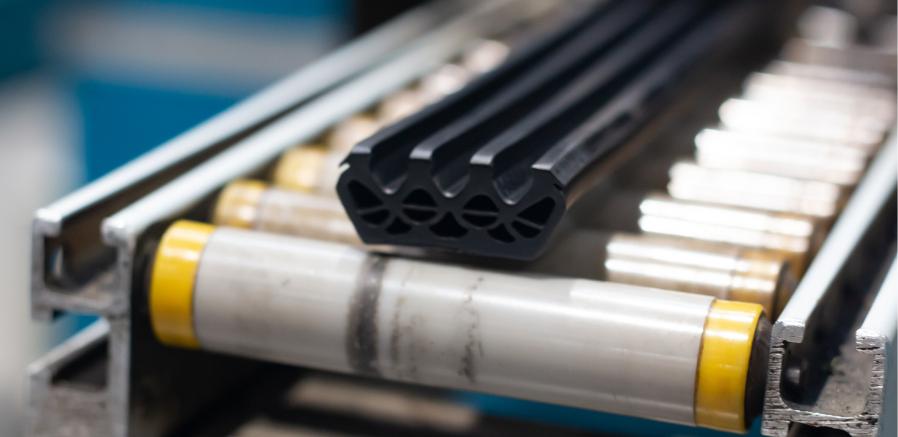
Top Rubber Manufacturing Companies in Connecticut
Connecticut has a long-established manufacturing tradition supported by aerospace, defense, medical, automotive, industrial, electronics, and specialized engineering industries. Within this ecosystem, rubber manufacturing companies in Connecticut produce and process elastomers for sealing, cushioning, vibration control, insulation, masking, labeling, gaskets, molded components, and other industrial applications.
The state's rubber industry includes both specialized manufacturers and companies focused on gaskets, die-cut products, rubber compounds, custom molded components, and engineered elastomer solutions. This diversity allows OEMs, engineers, procurement teams, and product developers to source rubber materials and components according to specific application requirements.
Top Rubber Manufacturing Companies in Connecticut
1. Griswold Products
Griswold Products is a Moosup, Connecticut-based manufacturer specializing in high-performance standard and custom cellular rubber. The company traces its history to 1949 and manufactures its products at its Connecticut facility. Its materials are designed for applications involving cushioning, sealing, shock absorption, non-skid performance, sound management, and vibration control.
Griswold serves markets including aerospace, automotive, defense, fitness, footwear, industrial, and recreation. Its cellular rubber materials can also be laminated to textile and film substrates for application-specific requirements. The company identifies ISO 9001:2015 compliance along with other regulatory and material-compliance programs.
Key capabilities include:
- Cellular rubber manufacturing
- Custom rubber materials
- Sealing products
- Cushioning materials
- Shock and vibration management
- Anti-skid and anti-fatigue products
- Substrate lamination
- Custom material development
2. New England Gasket
New England Gasket is located in Bristol, Connecticut, and specializes in custom gaskets, washers, seals, pads, O-rings, and stampings. The company has operated since 1986 and supports both prototype requirements and higher-volume production.
Its precision die-cutting capabilities allow customers to produce custom sealing and gasket components from a variety of materials. This makes the company relevant to manufacturers that require repeatable die-cut elastomer components rather than only conventional molded rubber parts.
Key capabilities include:
- Custom gaskets
- O-rings
- Seals
- Washers
- Die-cut rubber components
- Precision die cutting
- Prototype production
- High-volume production
3. Auburn Manufacturing Co
Auburn Manufacturing Co is a gasket manufacturer located in Middletown, Connecticut. The company provides custom gasket-related manufacturing and is positioned to support industrial customers requiring sealing components.
Gaskets are critical in applications where manufacturers need to prevent leakage, isolate components, or maintain reliable interfaces between mating surfaces. Material selection is therefore an important part of the manufacturing process, particularly when components are exposed to temperature, chemicals, pressure, or environmental conditions.
Areas to evaluate include:
- Custom gasket manufacturing
- Rubber gasket products
- Sealing components
- Die-cut parts
- Industrial sealing
- Custom specifications
- Production requirements
4. The Buswell Manufacturing Company
The Buswell Manufacturing Company is based in Bridgeport, Connecticut, and is included in the supplied list of rubber manufacturing companies.
Its manufacturing position makes it relevant to businesses researching custom polymer and fabricated-component suppliers in Connecticut. For rubber-related projects, buyers should confirm the exact elastomer processes, materials, tooling capabilities, production capacity, and secondary operations currently available.
Potential areas to evaluate include:
- Rubber and polymer components
- Custom manufacturing
- Fabrication
- Molded components
- Industrial products
- Prototype manufacturing
- Production support
5. Rubber Labels USA
Rubber Labels USA operates from Milford, Connecticut, and has a distinctive position within the rubber industry. Rather than focusing solely on conventional molded components, the company specializes in rubber labels, rubber compounding, calendering, printing, die cutting, and laser processing.
The company has roots in the historic U.S. Rubber and Uniroyal rubber-label operation and was brought back to Connecticut under family ownership in 2019. Its current focus includes high-performance rubber labeling as well as emerging smart-label and integrated-electronics applications.
Key capabilities include:
- Rubber label manufacturing
- Rubber compounding
- Rubber calendering
- Rubber sheeting
- Printing
- Die cutting
- Laser cutting and engraving
- Smart-label development
6. Gordon Rubber & Packing Co
Gordon Rubber & Packing Co is located in Derby, Connecticut, and operates in the rubber-products sector. The company is particularly relevant to manufacturers researching rubber products, packing materials, and industrial sealing solutions in Connecticut.
For industrial applications, rubber packing and related sealing products can be used to help control leakage, protect components, and maintain equipment performance. Customers should discuss material compatibility, temperature, pressure, dimensions, and operating conditions when specifying rubber products.
Areas to evaluate include:
- Rubber products
- Packing materials
- Sealing products
- Industrial rubber components
- Custom requirements
- Replacement components
- Industrial applications
7. Axel Plastics Research Labs
Axel Plastics Research Labs is based in Monroe, Connecticut, and operates in the specialty materials and chemical manufacturing sector. Its inclusion in a rubber manufacturing list is more closely related to rubber and polymer material technology than to conventional rubber-part production.
For manufacturers working with elastomers, additives and processing materials can influence mold release, processing efficiency, surface quality, and finished-part performance. Companies considering Axel should therefore verify the specific material-development or chemical products required for their application.
Areas to evaluate include:
- Polymer-related materials
- Specialty chemicals
- Rubber-processing solutions
- Material development
- Manufacturing support
- Industrial applications
8. Airex Rubber Products Corporation
Airex Rubber Products Corporation is a Portland, Connecticut-based manufacturer with a long history in custom rubber manufacturing. Established in 1943, the company specializes in precision molded rubber products, rubber-to-metal bonding, custom rubber masking, tooling, and engineered elastomer solutions.
Airex serves demanding markets including aircraft and aerospace, military and defense, medical, oil exploration, MRO, solenoid and control systems, pumps, valves, electronics, and commercial applications. Its quality system is based on AS9100 and ISO 9001, and the company identifies ITAR registration as part of its compliance profile.
Key capabilities include:
- Custom rubber molding
- Precision molded elastomers
- Rubber-to-metal bonding
- Custom rubber masking
- Elastomer development
- Mold tooling
- Engineering support
- Precision manufacturing
What Is Rubber Manufacturing?
Rubber manufacturing involves converting natural or synthetic elastomers into finished materials and components. Depending on the application, manufacturers may use processes such as molding, extrusion, calendering, die cutting, compression molding, transfer molding, injection molding, bonding, and custom compounding.
The manufacturing method depends on the required component geometry, material properties, production volume, dimensional tolerances, and end-use environment.
Rubber can be engineered to provide properties such as:
- Flexibility
- Elasticity
- Impact absorption
- Vibration isolation
- Sealing performance
- Chemical resistance
- Temperature resistance
- Electrical insulation
- Abrasion resistance
Common Rubber Manufacturing Processes
Rubber Molding
Molding uses specialized tooling to produce rubber components with defined shapes and dimensions. It is commonly used for seals, gaskets, mounts, boots, plugs, diaphragms, and other custom components.
Die Cutting
Die cutting uses a shaped tool to cut rubber sheet or other flexible materials into specific profiles. It can be particularly efficient for gaskets, pads, seals, and flat components.
New England Gasket, for example, identifies precision die cutting as one of its core manufacturing capabilities.
Rubber Calendering
Calendering produces controlled rubber sheets or coated materials by processing elastomer compounds through precision rollers. Rubber Labels USA identifies low-gauge, high-precision rubber calendering among its capabilities.
Rubber-to-Metal Bonding
Rubber-to-metal bonding combines an elastomer with a metal substrate to create a component that can provide both flexibility and structural support.
This process is particularly useful for mounts, seals, vibration-control components, and specialized industrial parts. Airex Rubber Products identifies rubber-to-metal bonding as part of its custom manufacturing capabilities.
Industries Served by Connecticut Rubber Manufacturers
Aerospace and Defense
Rubber components can be used for seals, vibration-control systems, insulation, masking, gaskets, mounts, and specialized aircraft components.
Airex and Griswold both identify aerospace and defense applications within their markets.
Medical Manufacturing
Medical products can require specialized elastomer components, seals, tubing-related products, protective components, and custom molded parts.
Material selection and quality controls are particularly important when rubber components are used in medical environments.
Automotive
Automotive systems use rubber for sealing, vibration control, insulation, cushioning, and numerous under-the-hood and interior applications.
Electronics
Rubber can provide electrical insulation, cushioning, sealing, vibration management, and protective functions within electronic products.
Industrial Equipment
Industrial machinery commonly uses gaskets, seals, pads, mounts, vibration-control materials, and other elastomer components to improve equipment reliability.
How to Choose a Rubber Manufacturing Company in Connecticut?
Choosing a rubber manufacturing company in Connecticut should begin with the application's technical requirements.
1. Identify the Required Elastomer
Natural rubber, silicone, EPDM, nitrile, neoprene, fluorocarbon, polyurethane, and other elastomers provide different combinations of temperature, chemical, mechanical, and environmental performance.
2. Define the Operating Environment
Manufacturers should identify exposure to temperature, chemicals, oils, fuels, water, pressure, UV radiation, abrasion, and mechanical loads.
3. Select the Right Manufacturing Process
Injection molding, compression molding, die cutting, calendering, extrusion, and fabrication each have different advantages.
4. Evaluate Tooling Requirements
Molded components generally require dedicated tooling. Tool design can influence dimensional accuracy, cycle time, material flow, maintenance, and long-term production costs.
5. Consider Production Volume
A process suitable for prototypes or low-volume production may not provide the best economics for high-volume manufacturing.
6. Review Quality Requirements
Aerospace, defense, medical, and other demanding applications may require specific quality systems, inspection documentation, traceability, and compliance requirements.
Airex, for example, identifies AS9100 and ISO 9001 certifications within its quality system. Griswold identifies ISO 9001:2015 compliance among its current compliance documentation.
Rubber Manufacturing vs. Plastic Manufacturing
Rubber and plastic are both polymer-based materials, but their properties and manufacturing behavior differ.
Rubber is generally selected when flexibility, elasticity, sealing, cushioning, or vibration absorption is important.
Plastic is often selected for rigid structures, lightweight components, enclosures, dimensional stability, and applications requiring specific mechanical or chemical properties.
Some products use both materials. For example, a rigid plastic housing may incorporate rubber seals or vibration-isolation components.
Why Connecticut Is an Important Rubber Manufacturing Location
Connecticut's manufacturing ecosystem provides access to established engineering, aerospace, defense, medical, industrial, and specialty-material markets.
The state's rubber industry also demonstrates the breadth of modern elastomer manufacturing. Companies on the list range from cellular-rubber manufacturers and precision molded-rubber specialists to gasket producers, rubber compounders, calendering operations, and rubber-label manufacturers.
This diversity gives OEMs and product developers multiple options depending on whether they need raw or semi-finished rubber materials, custom molded parts, die-cut seals, gaskets, specialty labels, or engineered elastomer products.
Conclusion
The top rubber manufacturing companies in Connecticut listed here represent a diverse cross-section of the state's elastomer and rubber-products industry.
For OEMs, engineers, procurement professionals, and product developers, the right supplier should be selected based on elastomer expertise, manufacturing process, material compatibility, tooling capabilities, tolerances, production volume, quality systems, certifications, secondary operations, and delivery requirements.
A detailed RFQ should include the part drawing or CAD model, material specification, operating temperature, chemical exposure, hardness requirements, annual quantity, tolerances, tooling expectations, inspection requirements, and delivery schedule. This information enables a rubber manufacturer to recommend an appropriate material and production process while providing a more accurate quotation.
Recent Posts
Tue Oct 06 2026
Top Plastic Manufacturing Companies in Connecticut
Thu Oct 01 2026
Top Electronics Manufacturing Companies in Connecticut
Wed Sep 30 2026
Top Metal Stamping Companies in Arizona
Tue Sep 29 2026
Top Laser Cutting Services Companies in Arizona
Mon Sep 28 2026
Top Sheet Metal Fabrication Companies in Arizona